Asbestos is a naturally occurring silicate mineral, mined primarily in Russia, Kazakhstan, China and Brazil. It entered UK homes through the widespread use of asbestos cement, insulation and textured coatings in construction between the 1950s and 1999, when all asbestos use was finally banned in the UK.
Used for thousands of years across a huge range of industries, asbestos has since been linked to serious health risks including lung cancer and mesothelioma, which makes it important to understand where it may be located in your home. But, interestingly, asbestos has a long and winding history that is entwined in cultures across the world.
When was asbestos discovered?
The exact time period in which asbestos was discovered is widely debated, as there is evidence that it was used in various cultures and practices globally for thousands of years. It may surprise you to learn that as a species, we were using asbestos long before it ended up a common material in 20th century construction.
It is reported that asbestos was discovered in a Greek quarry over 4500 years ago, and subsequently used in a number of textiles including cloaks, tablecloths, and as a strengthener for ceramics. It was often referred to as the ‘magic mineral’ due to its fire resistant properties.
The term ‘asbestos’ itself comes from the Greek word asbestos, which means ‘inextinguishable’.
It wasn’t until the 19th century that asbestos became widely used in industrial applications, particularly in construction, shipbuilding, and manufacturing.
Asbestos was first identified in a modern scientific context in the early 1800s.
Where does asbestos come from?
Asbestos is a naturally occurring mineral that forms in certain types of rock under specific geological conditions. It is found in large quantities in areas with particular types of rock formations, such as serpentine rocks, which are rich in magnesium silicate.
Asbestos is made up of thin, fibrous crystals that can be easily separated and woven into fabrics, or used in the production of insulation and building materials.
There are six main types of asbestos:
- Actinolite (amphibole): Actinolite was used in cement, insulation, paint, drywall and sealants.
- Amosite (amphibole): Amosite is the second most common type of asbestos and is found in insulation and tiles.
- Anthophyllite (amphibole): This type of asbestos has been used in cement and some insulation materials but is not used in consumer products.
- Chrysotile (serpentine): Chrysotile is known as white asbestos and was the most commonly used in construction.
- Crocidolite (amphibole): Crocidolite is referred to as blue asbestos and is less fireproof than other types.
- Tremolite (amphibole): Like other types of asbestos, Tremolite has been used in paint and sealants, but also plumbing materials.
Which countries does asbestos come from?
There is no one country in which asbestos can be found, but countries like England, Scotland and Germany had large asbestos industries during the height of its use. The location of asbestos mining does impact the type of asbestos found, for example:
- Canada: Chrysotile
- Italy: Tremolite
- Finland: Anthophyllite
- South Africa: Amosite
- Zimbabwe: Chrysotile
How did asbestos end up in our homes?
Asbestos became a common material in homes, offices, and other buildings during the early to mid 20th century due to its heat resistance, durability, and insulating properties. Its widespread use was largely driven by the increase in construction need during this time, where inexpensive materials were valued.
The dangers of asbestos exposure were not immediately apparent, and it wasn’t until the 1960s and 1970s that the health risks associated with asbestos became widely known.
By then, it had already been used extensively in construction materials. As a result, many older homes still contain asbestos in their insulation, flooring, roofing, and other materials.
Timeline: How Asbestos Entered UK Homes
Asbestos did not arrive in British homes overnight. Its use built up over several decades before mounting health evidence forced a series of partial bans, and finally a complete UK ban. The timeline below shows how asbestos entered UK housing decade by decade.
| Period | What happened in the UK |
|---|---|
| 1930s–1940s | The first UK asbestos regulations arrived in 1931, covering ventilation in factories. Asbestos cement and insulating board were already standard in industrial, commercial and public buildings. |
| 1950s | The post-war rebuilding boom made cheap, fire-resistant asbestos cement sheeting, Asbestos Insulating Board (AIB) and pipe lagging a default choice in new council housing, prefabs and schools. |
| 1960s–1970s | Peak UK usage. Textured coatings such as Artex, thermoplastic and vinyl floor tiles, garage and outbuilding roofs, boiler flues, airing cupboard panels and loose-fill loft insulation all commonly contained asbestos. |
| 1980s | Health evidence mounted and public pressure grew. In 1985 the import, supply and use of blue (crocidolite) and brown (amosite) asbestos was banned in the UK. |
| 1992 | The ban was widened to cover many more asbestos products, including a large number of chrysotile (white asbestos) applications. |
| 1999 | All remaining use of asbestos in the UK, including white asbestos, was banned outright. |
| 2012 | The Control of Asbestos Regulations 2012 consolidated earlier law and set out the duty to manage asbestos that remains in place in buildings today. |
The practical takeaway for homeowners is straightforward: any UK property built or refurbished before 2000 may still contain asbestos materials, and the older the building, the more likely it is. You can read more about the reasons behind the ban in our guide to why asbestos was banned in the UK.
Where Asbestos Is Found in UK Homes
Because asbestos was used in so many different products, it can turn up almost anywhere in a pre-2000 property. These are the places it is most often found in UK housing stock.
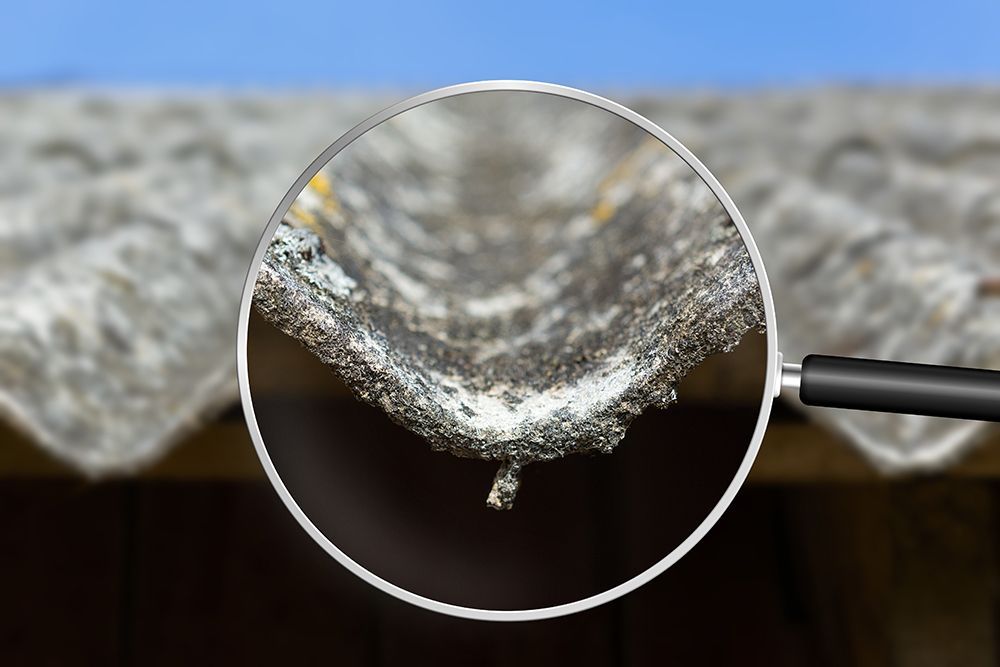
- Roofing and rainwater goods – corrugated asbestos cement roof sheets, roof tiles, soffits, fascias, guttering and downpipes. Asbestos cement is one of the most common asbestos materials still in place on UK homes.
- Insulation – pipe lagging around boilers and heating pipes, loose-fill or quilted loft insulation, and insulation around hot water tanks. Thermal insulation is among the highest-risk asbestos materials because it is friable and releases fibres easily when disturbed.
- Textured coatings (Artex) – decorative textured ceiling and wall finishes applied from the 1960s to the mid-1980s frequently contained a small percentage of chrysotile. Our guide to the difference between asbestos and artex explains how to tell them apart.
- Floor tiles and floor coverings – nine-inch thermoplastic and vinyl floor tiles, the bitumen adhesive used to fix them down, and the backing of some vinyl sheet flooring.
- Boiler flues and heating components – asbestos cement flue pipes, boiler and warm-air heater panels, storage heater linings, oven door seals and old fire blankets.
- Garages, sheds and outbuildings – corrugated asbestos cement garage roofs and wall panels are extremely common on UK properties, and are often the first material homeowners ask us to remove.
- Walls and ceilings – Asbestos Insulating Board used for partition walls, ceiling tiles, airing cupboard linings, soffits and infill panels around windows.
For a room-by-room breakdown, read our full guide to where asbestos is found in residential properties. Because most of these materials look identical to their modern asbestos-free equivalents, the only reliable way to confirm what you have is laboratory analysis of a sample taken during an asbestos survey and sampling visit.
When was it discovered that asbestos was dangerous?
Even before it was widespread knowledge that asbestos is dangerous to health, there was significant evidence to suggest that long term exposure caused harm.
In fact, Strabo, a Greek geographer in Ancient Greece, noted a ‘sickness of the lungs’ in people who were enslaved and had frequent contact with asbestos, most noticeably those who wove asbestos fabrics.
Even later, a Roman historian attempted to create an early form of face mask from goat’s bladder to protect slave miners from an unknown threat that caused a ‘disease of the lungs.’
Although these scholars were unaware of exactly what was causing this sickness, the evidence of the dangers of asbestos has been present since it was first used.
The first documented death of an asbestos worker occurred in 1906 when a pulmonary failure was reported at Charing Cross Hospital in London. A build up of asbestos fibres was found in his lungs during autopsy. The first reported diagnosis of asbestosis was in 1924 when a woman died at the age of 33 from 20 years of prolonged exposure to asbestos.
Because of this, a report was conducted that found 25% of asbestos workers in England showed signs of asbestos related illness in their lungs.
It is then reported that the dangers were brought to the attention of a number of people resulting in increased insurance premiums for asbestos workers, as further reports in asbestos factories across the world found similar early deaths from respiratory failure.
In 1931, laws were passed that insisted on additional ventilation in factories where asbestos was used. Following this, medical journals published numerous studies that linked asbestos to cancer, but it is thought to have been overshadowed by the recognition of silicosis and its subsequent lawsuits.
At this time, the need for asbestos containing materials (ACMs) outweighed these findings, and so asbestos use wouldn’t be banned until decades later. In the UK, asbestos use was completely banned in 1999.
Despite its ban, asbestos can still be found in many older buildings, and its potential health risks make it important for homeowners and businesses to be aware of where it may be located.
Frequently Asked Questions About Where Asbestos Comes From
Yes. Although asbestos is banned in the UK and more than 65 other countries, it is still mined and exported commercially, mainly by Russia, Kazakhstan, China and Brazil. Russia is by far the largest producer, and most of the chrysotile mined today ends up in construction products in Asia.
Asbestos was used in British industry from the mid-1800s, with the first UK asbestos factories opening in the 1870s. Its use in ordinary housing took off from the 1930s and became widespread during the post-war building boom of the 1950s. It continued until the final UK ban in 1999.
You cannot identify asbestos reliably by eye, because asbestos cement, insulating board and textured coatings look the same as their modern replacements. If your property was built or refurbished before 2000, work on the assumption that asbestos may be present. Laboratory analysis of a sample taken by a qualified surveyor is the only way to confirm it.
Asbestos in good condition, sealed and unlikely to be disturbed, is generally safer managed in place than removed. The danger comes from damaged or deteriorating materials, and from drilling, sanding, cutting or breaking them during DIY and renovation work, which releases fibres into the air. If you suspect asbestos, leave it alone and have it assessed.
At Cordtape, we can assist you with locating and identifying Asbestos Containing Materials within your domestic or commercial property with our Asbestos Survey and Sampling service. If we do locate the presence of asbestos, our Asbestos Removal team will extract it from your premises in accordance with Control of Asbestos Regulations 2012. Our team is fully qualified to manage all aspects of asbestos assessment, removal, refurbishment and waste management so you don’t need to live in fear of the risk this material poses.
Contact us today.
Email: info@cordtape.co.uk
Phone: 0800 093 7810